
The Corpus of ROMANESQUE SCULPTURE in Britain & Ireland
St Mary, St Peter and St Paul (medieval)
Parish church
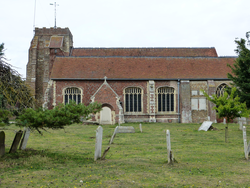
St Osyth is a village in the Tendring district of E Essex, 3 miles W of Clacton-on-Sea and 10 miles SE of Colchester. The village is surrounded by water, with St Osyth Creek to the S and Flag Creek to the W, both of which flow into the estuary of the River Colne. St Osyth Priory, an Augustinian house begun in 1118, dominates the centre of the village, and the parish church stands to its SE, just outside the priory walls.
The present church has an aisled nave with 5-bay brick arcades dating from the 16thc, wide aisles also of brick, N and S porches, N and S transepts, a chancel with N and S chapels, both converted to other uses, and an early 14thc W tower. The 16thc work widened the nave to the S, so that the chancel is now off-centre with respect to the nave. The line of the original, 12thc S arcade is indicated by the survival of its W respond, well to the N of the present arcade. There is also a loose scallop capital on the window-sill of the former S chapel (now the kitchen).
Ruined church, formerly Augustinian abbey
Keynsham commands a strategic position on the south side of the Avon, overlooking both that river and its tributary from the Mendip Hills to the south, the Chew. It controls the road between Bristol (giving access to the Bristol Channel and beyond) and Bath (giving access to London) on its side of the river. The road now running from Keynsham to Willsbridge, west of Bitton, probably represents an important ancient route.
Keynsham Abbey was founded as a house of Augustinian canons c1166. The Abbey precinct occupied c.18 acres above the left bank of the Chew, c.200m above its confluence with the Avon. After the Dissolution, the Abbey was demolished piecemeal over 400 years. The Abbey Church lay in a garden in Abbey Park, and has been the subject of several excavations which have yielded Romanesque sculpture (Brock, 1875, Lowe et al. 1987, 2004, 2005). There is a plan of the Abbey in Lowe 2004 and on the Keynsham Abbey website. Elements of sculpture from the Abbey can be seen embedded in the late 17thc archway of Park House (formerly Keynsham House). There is a lapidary collection in Keynsham Town Hall. Other elements of sculpture are located in the Crown Inn, the former Somerdale Factory site and Bristol Road arches. These sites are the subject of separate reports.