
The Corpus of ROMANESQUE SCULPTURE in Britain & Ireland
none (medieval)
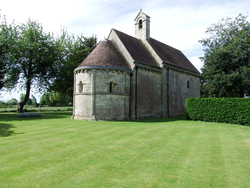
Chapel, formerly parish church
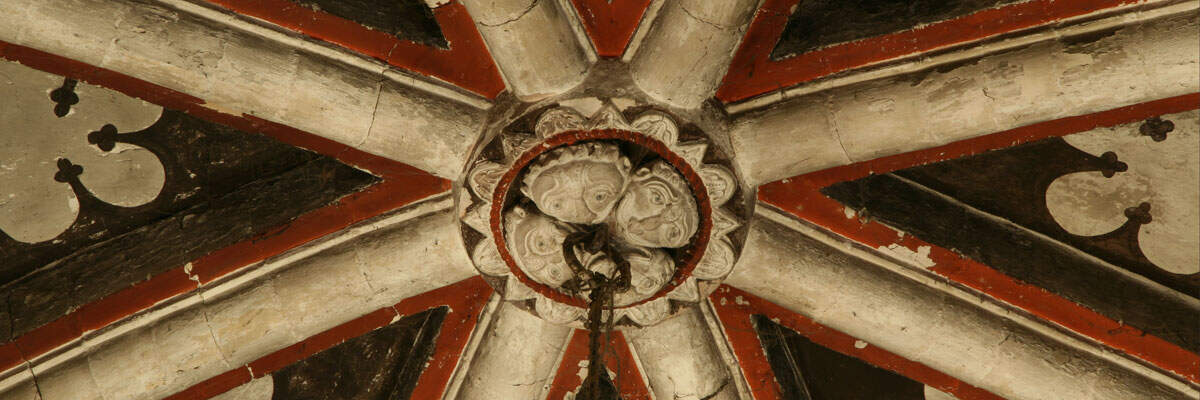
Steetley is a hamlet of a few houses within the civil parish of Whitwell, in the Bolsover district of Derbyshire. The nearest town of any size is Worksop, 3 miles to the E, over the Nottinghamshire border. Steetley chapel is a complete Norman church comparable in status and value to Kilpeck (Herefordshire), Iffley (Oxfordshire) or Stewkley (Buckinghamshire). It is built of a fine-grained creamy Magnesian limestone or dolomite quarried nearby (Stanley 177) and consists of a nave and chancel with a vaulted apse, and a S doorway to the nave, built on a projection with a latticed gable above it. The doorway itself is richly ornamented, but the gable decoration and much of the sculpture is 19thc work. The apse is buttressed by four pilasters connected by a foliate stringcourse. Otherwise the exterior is plain, except for the 19thc corbel table which supports the roofs of apse, chancel and nave; the only alteration (prior to the restoration of 1880) to the 12thc. fabric was the insertion of a Dec. window in the S wall of the chancel. On the interior, there are elaborately ornamented chancel and apse arches. The apse itself consisting of a short, tunnel vaulted bay and a hemispherical termination, the two parts separated by a transverse arch, is vaulted with beakhead ribs and elaborately carved capitals.
Much of the interior sculpture is badly weathered and it is clear from its condition that it has been roofless at some time and for a considerable period. When Cox saw the chapel shortly before 1875 it was 'long since desecrated' and was in use as a poultry yard. A few years earlier, in 1873, there was a visit by the British Archaeological Association and the description and a drawing make it clear that the chapel was at least partly roofless then. From this report we learn that the apse had been in a ruinous state but had been rebuilt by the then owner, the Earl of Surrey, about forty years earlier. Cox's account includes the infomation that lead was stolen from the roof of the chapel at the end of the 18thc, and that by 1742 it had been converted for use as a barn. The church was restored by J L Pearson in 1876-80 and is now a joint parish with St Lawrence, Whitwell.
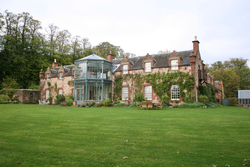
Private house
The Stable House at Tyninghame is the S wing of the former stables of Tyninghame House. It, and the other stables, have been subsequently developed into a series of private houses, of which the S wing is the oldest part. Built into the fabric of the building are numerous, re-used medieval stones, many of which are 12th century. It has been assumed (most likely correctly) that the stones come from the nearby church of St Baldred, which is now a folly ruin in the grounds of Tyninghame House. Although the Earl of Haddington purchased the estate in 1628, the date for the construction of the Stable House appears to fall into the period 1761-1829. The church of St Baldred ceased to operate in 1761 when the old village was moved to a new location. In 1829, William Burn was employed to make make significant architectural changes to both Tyninghame House and its stables, work on the stables apparently undertaken in the early 1830s. As Burn's stable blocks were attached to what is now the Stable House, the Stable House must be older, as noted by Historic Environment Scotland in the Listed Buildings report. No medieval stones appear to have been used in the stable blocks designed by Burn. Tyninghame House and its policies, on which the Stable House is built, were sold in 1987, a year after the death of the 12th Earl of Haddington. The stables were made into houses in 1988, a date displayed above the north entrance of the Stable House.