
The Corpus of ROMANESQUE SCULPTURE in Britain & Ireland
St Mary the Less (now)
Parish church
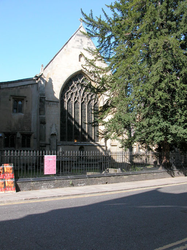
Little St Mary's stands on Trumpington Street in the city centre. The present church consists of a single-unit mid-14thc. rectangular church with no aisles, a S vestry with a crypt below and a stair above linking it to Peterhouse College, a S chapel of 1931 by T. H. Lyon , a 19thc. S porch at the W end of the nave, a 19thc. NW porch, and a W choir vestry, added in 1892-93 and now used as a parish room. The E window tracery reveals workshop connections with the Lady Chapel at Ely. There was a major restoration by Sir George Gilbert Scott in 1857-62, and the interior was whitewashed in the 1950s by Stephen Dykes-Bower. None of the present fabric is any earlier than the 14thc., but there is a nook shaft with chevron ornament set into a corner of the NW porch, presumed to be from a 12thc. church on the site.
Parish church
The church is composed of an aisless nave and narrower, rectangular chancel. The carved medieval-type detailing is mostly (possibly all) neo-Romanesque, the result of a reconstruction of the church in 1846-7 by George Pickering. Sited in the South Bailey, the church sits just outside the SE corner of the priory walls. It appears always to have been a parish church for the use of those living in the south bailey, owned by neither the priory nor the cathedral. Numerous repairs to the church are recorded in the 18thc. and early 19thc. In 1780 an estimate and proposed elevation drawing were made for rebuilding the church. This proposal, however, was never carried further (Durham County Archives, no. EP/Du. ML 9). In 1919, St Mary-the-Less became the chapel for St John's College, University of Durham. The carved stones, formerly loose behind the church and presently inside the church, are recorded to have been in the church cemetery in 1892 (Boyle, p. 377). The church lies E-W but is not quite at the same orientation as the cathedral. It is sited on the N side of the South Bailey Road, the road beginning at the priory gate (now called the College Gate) and continuing to the S end of the peninsula, where the present Bailey Gate (known as the Watergate) is sited. From here it leads down a path to Prebend's Bridge where nearby, in the medieval period, there seems to have been a ford across the River Wear.