
The Corpus of ROMANESQUE SCULPTURE in Britain & Ireland
Parish church
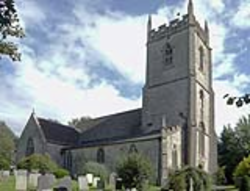
Nunney lies 3 miles W of Frome, Somerset. The ‘island of nuns’, in a pleasant shallow valley at the E end of the Mendips, lies to the SE of several local limestone quarries. A Cistercian nunnery was established in 1162. There is a 14thc castle and other evidence of previous importance. The church of All Saints (formerly St Peter) is built of coursed and squared Doulting rubble with ashlar dressings, and has a cruciform plan with a W tower, aisled nave, S porch and chancel. The Romanesque elements comprise the tub font and a possible sculpture of uncertain date in the N arcade.
Parish church
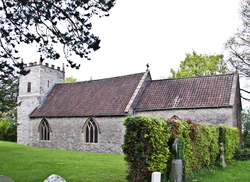
Saltford extends westwards from the L bank of the Avon between Bath and Keynsham (4 miles from the former and 2 miles from the latter), on either side of the main A4 between Bristol and Bath. The church is at the N edge of the village only 300m from the river, accompanied by the manor house dating from the Norman period and reputably the oldest habitation in the country. Geologically, Saltford exploits (like many settlements in this area of N Somerset) an unusually large area of limestone bedrock: specifically Blue and White Lias of the Lower Lias division of Jurassic rock. The place-name signifies ‘salty=tidal ford’ although various weirs now prevent the river being so up to this point. Saltford’s relatively low-lying position in the Avon valley alone must have occasioned considerable traffic and exploitation of resources; further, communication from the R bank which gave access to the Roman road running north of the Avon between Bath and the port at Sea Mills (W of Bristol) would have enhanced its utility.
The church is of 12thc or possibly Saxon origin, with some mid 17thc rebuilding following Civil War damage in 1643. It was restored and remodelled in 1832, with much of the walling rebuilt on earlier foundations. The font might have 12thc origins but has been remodelled.
Parish church
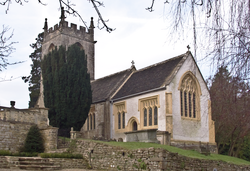
Where the river Avon runs past Batheaston, 2.5 miles NE of Bath city centre, it makes a right-angle turn. At that angle, from the N, the river receives the water of St Catherine’s Brook, which stream runs down steep (and quite well-wooded) valleys from the Cotswold plateau near Cold Ashton and Marshfield over the county border in Gloucestershire. Northwards from a point about 1 mile from its confluence with the Avon, St Catherine’s Brook forms the boundary between Somerset and Gloucestershire. The parish of St Catherine is the most NE in Somerset, well ensconced by the S folds of the Cotswolds. About 1.8 miles from Batheaston a lane runs past the nucleus of the Court, the Court Farm and the Church of St Catherine: there are few other buildings. Indeed, the whole valley has clearly not attracted settlement apart from farms; it is extremely sequestered despite its proximity to Bath and major communication routes.
The church sits at an altitude of about 85m above OD (about 35m higher than the Brook). The church was built in the 12thc as a chapel of ease for Bath Abbey, and was altered and remodelled extensively c. 1490 for Prior Cantlow of Bath. The Romanesque elements consist of a chamfered tower arch and the font.
Museum
Reading abbey stones1. Holme Park, Sonning (Keyser)In 1912 Charles Keyser was engaged in excavating the site of the palace of the bishops of Salisbury on the Holme Park estate, Sonning. While the excavations were in progress, Keyser took the opportunity to look around the house (now Reading Blue Coat School) and its gardens about a quarter of a mile away, and he noticed some Norman capitals lying about in the flower-beds. He soon discovered that the stones had not been in the gardens at Holme Park for very long, but had come there from an outlying part of the estate called Borough Marsh, some two miles down the Thames. He obtained the owners' consent to remove them from Holme Park, and by 1916 the fifteen capitals and two voussoirs had been deposited in Reading Museum. Keyser (1916) illustrated all the stones, and numbered the capitals from 1 to 15. He did not number the voussoirs.2. Shiplake HouseIn 1889, twelve voussoirs and fourteen double springers were erected by the Rt. Hon. Sir Walter Phillimore, Bart. to form an arch over the path between Shiplake House and the church, and a decorative coping on top of the wall to either side. Keyser discovered their provenance while he was at Sonning. One Mr Palmer, the owner of Holme Park estate at some time in the late 19thc., had paid a visit to Borough Marsh and interrupted two young men in a punt who were busy removing several carved stones which were in use as steps leading up from a landing place on the island. The young men had come from Shiplake House, which faces Borough Marsh across the Thames, and Mr Palmer gave them permission to carry the stones away on condition that they did not take any more. The stones were seen in situ at Shiplake by Keyser, and he numbered them (Keyser (1916)) according to their positions: the voussoirs from 1 to 12 counting from the left of the arch; the springers from 1 to 7 from right to left along the wall to the right of the arch, and from 1 to 7 from right to left along the wall to the left of the arch. These identifying numbers are given in the entry headings below. He also noted three carved stones built into the wall but did not illustrate them. The voussoirs and double springers were purchased by Reading Borough Council from Col. Phillimore in 1977, when they were dismantled and removed to the museum.3.Borough Marsh (CL#)In view of the discoveries described above, Keyser visited Borough Marsh and was attracted by signs of a ruined building which led him to the opinion that excavations at Borough Marsh might result in more finds, but the Great War intervened and he was never able to carry out his plans. In 1948, George Zarnecki of the Courtauld Institute of Art was alerted to the presence of carved stones at Borough Marsh Farm similar to those forming the Shiplake arch. The owner of the farm generously gave the stones to the Courtauld Institute. In fact, Borough Marsh Farm was not the site that had attracted Keyser's attention thirty years before, but this did not become apparent until Dr Wilfred Bowman, owner of Barn Acre Cottage, Borough Marsh, built himself some new gate-posts using carved stones he had found in his garden. News of these stones quickly reached Zarnecki in London, and in the autumn of 1948 he led a group of staff and students from the Courtauld Institute to Barn Acre Cottage.What he found left him in no doubt that he had found the site that Keyser had hoped to excavate. The garden was bounded by the River Loddon, and its level had been artificially raised by a 16thc. embankment wall to prevent flooding and soil erosion. Some of the fabric of this wall was reused 12thc. stone, clearly from Reading Abbey. In the garden of Barn Acre Cottage, Zarnecki's team also uncovered the foundations of a building complex, made of brick reinforced with stone.Zarnecki's excavation at Barn Acre Cottage brought to light some sixty carved stones, including two of the four great corner springers which marked the angles of the cloister arcade.The stones were generously given to the Courtauld Institute by Dr Bowman, and after cleaning they were lodged in the Victoria and Albert Museum until such time as they could be accommodated in the Reading Museum. Plans for a new museum building were approved by Reading Corporation in 1973, and in the same year the Courtauld Institute Management Committee accepted Zarnecki's proposal that the stones be transferred from the V and A to Reading as a gift to the museum. The transfer was completed on 16th. October 1975. These stones were marked "CL" followed by a digit (for Courtauld Loan), and these identifications are given in the entry headings below.4.Avebury ManorA capital at Avebury Manor, Wiltshire, carved with men and dragons, which had been taken there from a garden in Reading was first examined by Zarnecki in 1959 and proved to be another Reading Abbey cloister capital. After lengthy negotiations it was purchased by Reading Museum for the sum of £6,250 (including a grant of £1,000 from the National Art Collections Fund) in 1971.5.TwyfordThree further pieces, a double springer carved with birds, a lion capital and a bird beakhead voussoir, were purchased by Zarnecki from a private collector in Twyford, Berkshire, and offered to the museum on loan on 2. September 1971. They have now joined the other fragments in Reading Museum.6. Plummery wall7.Forbury Gardens rockery8.Wall to west of St James's church9.Unprovenanced fragmentsBy and large the museum has been assiduous in keeping records of provenance, but in 1993 when all the stones were at last moved into the enlarged premises in the Town Hall it was discovered that there were several which had been in store for many years for which no provenance was known. They may have been there for many years: Keyser (1916) refers to "a few (stones) in the Reading Museum dug up in various parts of the town."
Parish church
Marksbury is a small village in Somerset sited near the Chew valley, about 5.5 miles SW of Bath and 13 miles NE of Wells. The meaning of the place-name (‘boundary-fort’) suggests potentially significant history (Costen, 1983). S of the Avon Valley, E of the Chew Valley and W of Newton Brook Valley, Marksbury is in a historically active area and nowadays part of a favoured, prosperous district either side of the Avon. The bedrock on which the village rests is the Lower Lias known as ‘Blue Lias’. There is a quarry marked on nineteenth-century OS mapping immediately W of the village. One of the site photos, taken from the neighbouring parish of Farmborough, gives a view across the relatively flat land of Marksbury Plain to the church tower and beyond to the hills of Winsbury and Stantonbury. The original settlement lies offset below and to the NW of the A39, which is a long-established route along the high ground.
The church of St Peter therefore would seem originally to have occupied an almost solitary commanding position (at 124m above OD) on the high ground of the ridge, isolated except for its farm close-by on its SW side. The church consists of W tower, nave, N porch and chancel. The church is of late 12thc origin, but mainly dates to the 15thc, and was extensively restored in 1875. The only Romanesque feature present is a 12thc font.
Parish church
The plain round-headed S doorway is now largely renewed but includes some 12thc. mouldings. Various carved fragments at the rectory mentioned in the VCH (19.., 3: 17) have now disappeared, but two are recorded in photographs.