We use cookies to improve your experience, some are essential for the operation of this site.

HomeSearchAboutResourcesLog InRegister

The Corpus of ROMANESQUE SCULPTURE in Britain & Ireland
Search
 
Country
    Dedication (now)
      Dedication (medieval)
        Boundaries (now)
          Boundaries (traditional)
            Diocese (now)
            • Truro
              Diocese (medieval)
                Type of building/monument
                  Feature set

                    Truro (now)

                    of 6
                     
                    St Mary, Braddock, Cornwall

                    Bradoc

                    St Mary, Braddock, Cornwall

                    Parish church
                    Braddock, formerly Broadoak and sometimes Bradoc, is a village in south central Cornwall, 7 miles W of Liskeard and 5 miles SE of Bodmin. The population was 156 in 2011. The church sy-tands in the village centre, and is constructed of rubble. It consists of a W tower of 2 storeys, a nave with a S aisle and a S porch, and a chancel continuous with the nave. It was originally cruciform, and the N transept was rebuilt in the mid-19thc with an E vestry. The only Romanesque feature is a 12thc font.
                    St Ciricius and St Julitta, Luxulyan, Cornwall

                    Luxulyan

                    St Ciricius and St Julitta, Luxulyan, Cornwall

                    Parish church, formerly chapel
                    Luxulyan is a village in mid Cornwall, 6 miles S of Bodmin, and is the site of a granite quarry. It is in the valley of the River Par, designated a World Heritage Site for its important early 19thc. industrial remains. The church stands at the E edge of the village and is of granite ashlar with granite dressings. It consists of a nave and chancel in one with N and S aisles to the nave, a S porch and a W tower with a NE stair turret, and is substantially 15thc. in date, and restored in the late-19thc. The only Romanesque feature is the font, of the Bodmin type but not by that workshop.
                    St Rumon, Ruan Minor, Cornwall

                    Ruan Minor

                    St Rumon, Ruan Minor, Cornwall

                    Parish church
                    The church is one of the smallest in west Cornwall, and is in an exposed position close to the tip of the Lizard. The church was mostly constructed in the 14thc. and 15thc, but it originated as small chapel with a chancel and nave.  The only Romanesque features are the font, and possibly the piscina.
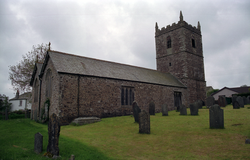
                    Holy Name, Boyton, Cornwall

                    Boyton

                    Holy Name, Boyton, Cornwall

                    Parish church
                    Nothing remains from the Norman church except the font and the lower part of the chancel walls; no architectural sculpture.
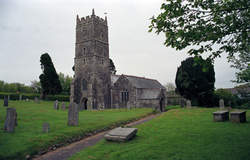
                    St Sampson, South Hill, Cornwall

                    South Hill

                    St Sampson, South Hill, Cornwall

                    Parish church
                    South Hill is a hamlet in east Cornwall, 7½ miles S of Launceston. The church stands in the centre of the settlement and is substantially 14thc with 15thc additions. It was restored in 1871. The font is the only Romanesque feature.
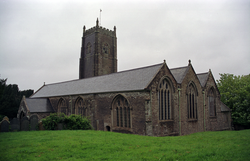
                    St Stephen, St Stephen by Saltash, Cornwall

                    St Stephen by Saltash

                    St Stephen, St Stephen by Saltash, Cornwall

                    Parish church
                    The body of the church is Perpendicular, although clearly not all of one build. The only feature earlier than the 15thc is the Romanesque font.
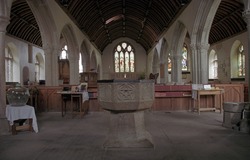
                    St Martin, Lewannick, Cornwall

                    Lewannick

                    St Martin, Lewannick, Cornwall

                    Parish church
                    The church is of standard Cornish type, double-aisled with five bays, and a W tower.The font is the only surviving Romanesque feature.
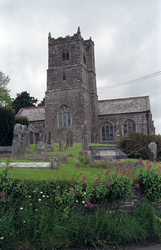
                    St Petroc, Bodmin, Cornwall

                    Bodmin

                    St Petroc, Bodmin, Cornwall

                    Parish church
                    Bodmin is a town (pop. 16,440 in 2021) in the centre of Cornwall to the SW of Bodmin Moor. The church is in the centre of the town. St Petroc's church, 151 feet long, with a tower that was 150 feet high until the spire was destroyed by lightning in 1699, is the largest parish church in Cornwall. It was rebuilt in the period 1469-1491, but the N tower is Romanesque up to the third storey, unbuttressed, with small plain windows, and strongly receding from storey to storey. Both Sedding and Pevsner agree that it was probably the N transept tower of the Norman church (viz. e.g. Blisland), which would have been the same length and height as the fifteenth century one, although with narrower aisles. The plan consists of a 6-bay nave with a 3-bay chancel, N and S aisles, a N tower sited at the junction of nave and chancel and a S porch. Construction is of local coursed and squared stone with freestone and granite dressings. The only Romanesque sculpture to have survived to the present day is the splendid font, the largest and most elaborately carved example of a type peculiar to Cornwall, although the Norman W front survived until 1814, and included a fine sculpted doorway, of which a drawing survives.
                    St Michael, Lawhitton, Cornwall

                    Lawhitton

                    St Michael, Lawhitton, Cornwall

                    Parish church
                    St Michael's is a small church built on an unusual plan. The 13thc tower stands in the place of a S transept, which also has a 15thc. porch. Most of the decorative features, such as the tracery, are Perpendicular. The only Romanesque sculpture in the church is a 12thc font.
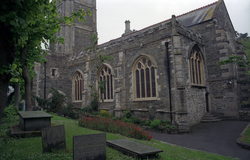
                    St Finbarrus, Fowey, Cornwall

                    Fowey

                    St Finbarrus, Fowey, Cornwall

                    Parish church
                    The church is the Cornish standard of two aisles on a central vessel, but earlier than the usual date: the church was rededicated in 1336. There are additions of the 15thc. Only the font is Romanesque.
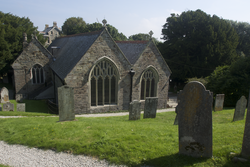
                    Page 1 of 6
                    AboutContactHealth and Safety PolicyPrivacy PolicyCopyright

                    The Corpus of ROMANESQUE SCULPTURE in Britain & Ireland

                    © 2026 The Corpus of Romanesque Sculpture in Britain and Ireland