
The Corpus of ROMANESQUE SCULPTURE in Britain & Ireland
"all saints huntingdon"
Parish church
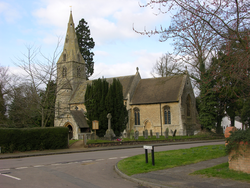
The largely 13thc. church has a W tower with a broach spire, an aisled nave of four bays, a N transept and a square-ended chancel. The tower was rebuilt in 1868-70. The only feature described here is the S doorway, protected by a porch.
Parish church
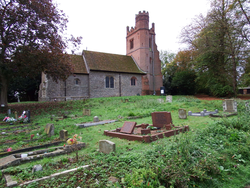
Inworth is a village in the Colchester Borough Council area of the county, 8 miles SE of Braintree and 10 miles SW of Colchester. It has no obvious centre, consisting of scattered houses along the B1023 road from Kelvedon to Tiptree. The civil parish is Messing cum Inworth; Messing being a village a mile to the NE.
The church is alongside the B1023, and consists of a chancel with a nave, S porch and W tower. Nave and chancel are of flint, puddingstone and Roman brick. The brick tower dates from 1876-77 when it was constructed by Rev. A. H. Bridges. A watercolour of 1827 shows a bell turret with a short broach spire over the W gable of the nave. The chancel is late-11thc with windows deeply splayed inside and out, having exterior dressings of puddingstone blocks, roughly shaped. It was later extended. Inside are wallpaintings of c.1300 showing scenes from the life of St Nicholas. No dedication is known before 1515 and it has been suggested that the paintings are evidence of the earlier dedication. The chancel arch is the only feature recorded here.
Museum, formerly hospital
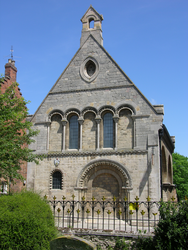
The Cromwell Museum is situated in the medieval centre of the town, immediately E of All Saints parish church. It was formerly the Grammar School attended by Oliver Cromwell and houses a display dedicated to him, but was built as the infirmary hall of the Hospital of St John the Baptist.
In its present state it is simply a rectangular box with a pitched roof and gabled ends at E and W, but it was originally longer and aisled. What remains are the two W bays without their aisles. The arcade piers and arches remain, but the bays have been blocked and triplet windows inserted in the arches. At the E end a plain gabled wall has been built to close off the structure, and a simple pointed doorway and a three-light window in a late-14thc style inserted. The doorway is a reused medieval piece, probably 13thc, but the window is entirely 19thc. The W facade is the glory of the building, with an elaborate off-centre 12thc doorway with rich chevron decoration, a chevron-decorated lower window, and at higher levels arcading that frames the two upper windows and a single oculus in the gable.
Much of what we see results from a restoration in 1878, when it was completely rebuilt, and the 19thc brickwork used to raise it by 3 feet is visible at ground level. Much of the original sculpture was reused, including most of the decorated W doorway and window, parts of the W facade arcading, and the bases and capitals of the arcades.
It is clear from the E pier of the S arcade that the building originally extended further E. Pevsner states that it was seven bays long, and that there was a courtyard to the N around which the Master’s lodging, the refectory and other buildings were arranged.
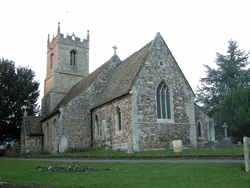
Parish church
Hartford is a village on the eastern edge of Huntingdon, on the N bank of the Great Ouse. The church is at the S edge of the village, alongside the river but high enough above it to avoid all danger of flooding. It is built of rubble with Barnack and other ashlar dressings, and consists of a chancel with a N vestry added in 1895; a nave with N and S aisles and a S porch; and a Perpendicular W tower with a projecting S bell stair. On the N side of the church is an extension opened in 2004 with a hall, kitchen and lavatories and accessed from the exterior and through the N nave doorway of the church. The chancel has 12thc N and E walls with no sculptured features. Otherwise it is of the 14thc but remodelled by Robert Hutchinson in 1861, including an elaborate neo-Romanesque chancel arch. The nave arcades are of the end of the 12thc; the N stylistically earlier. Romanesque features described here are the greatly restored S nave doorway, the two nave arcades and the font.
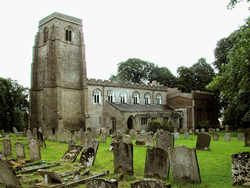
Parish church
12thc. nave with later aisles. The nave is six bays long, and on the N side the Perpendicular arcade is indeed of six bays. The S
aisle, raised above the level of the nave, is largely of c.1200 with
chamfered round-headed arches and moulded capitals, but
the arcade is only four bays
long on the inside (bay 4 is Perpendicular). On the
outside the aisle is seen to continue westwards for a fifth bay, which acts as a porch for the
12thc. S doorway. This still leaves one unaisled bay,
and in this is a small, round-headed, 12thc. window. The chancel has a brick S chapel of c.1500, the North Chapel,
built by the first Baron North who died in 1564, and whose tomb it houses. The
W tower is Perpendicular, along with the clerestorey of
the nave, and it is clear that a major remodelling took place around 1500.
Apart from the North Chapel the construction is of flint and pebble with a good
deal of render.
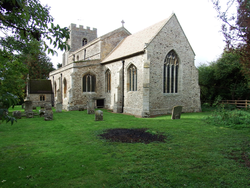
Parish church
Great Paxton is a village on the E bank of the Great Ouse, 3 miles NE of St Neots. The church lies W of the High Street in the villlage centre. It is built of pebbles and ashlar rubble set in mortar, and consists of a 2 bay chancel, a clerestoreyed nave with N and S aisles, a S porch and a vestry at the W end of the N aisle. The W tower is a 14thc addition. So much is visible from the exterior, although the observant visitor will have noted the unusual height of the nave and the round-headed windows of the clerestorey. Inside it becomes clear that this was originally a cruciform church with aisles - an unusual combination. The nave has been cut short at the W end, and is now 2½ bays long. The arcades are comparatively low, and above them is a large expanse of blank wall below the clerestorey level, suggesting an original scheme of wallpainting. The clerestorey windows themselves are wide, tall and completely plain.
The original building would certainly be called Romanesque were it elsewhere in Europe, but it is generally assumed to be pre-Conquest. This includes the nave and its arcades (thus the aisles too, which were later widened), the crossing including the transepts and the original E crossing arch, now the chancel arch. There is assumed to have been a crossing tower on the evidence of the substantial crossing piers. There is no sign of a W crossing arch, which would certainly have been necessary if there were a tower, but the entire interior is covered with a thick coat of whitewashed plaster which would conceal any telltale scars. The chancel was rebuilt in the late-13thc, the aisles and the S porch in the 14thc. When the W tower was built in the 14thc the nave was shortened. Presumably at that time the central tower was removed, the chancel arch was remodelled, and the S transept was lowered and given a new pointed arch.