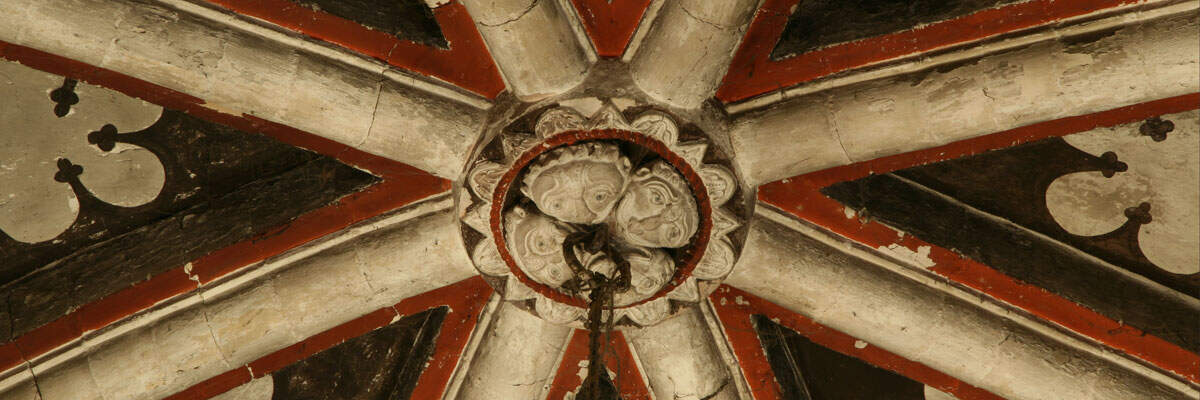
Aylesbury is an ancient settlement in the centre of Buckinghamshire. An Iron Age hill
fort was excavated in the town centre in the 1990s, and the town lies on Akeman
Street, the Roman road from Bicester. In the Anglo-Saxon period it was already an
important market town, although the county town was then Buckingham, in the NW of the
county. Aylesbury superseded Buckingham as the county town in 1529, following a
declaration by Henry VIII. According to rumour Henry was trying to please Thomas
Boleyn, who held the manor and whose daughter, Anne, the king wished to marry, but
Aylesbury was also growing quickly at that time, and was more centrally sited than
Buckingham.
The Vale of Aylesbury runs from W to E through the town, and is a continuation of the
Vale of the White Horse, largely in neighbouring Berkshire. It is a lowland,
agricultural region on a clay substrate, supporting mixed farming and especially
dairy cattle. The surrounding landscape is generally wooded with hedges. Aylesbury
was always a market town rather than a manufacturing one, although flour was ground
there for the surrounding parishes from the later middle ages until the 20thc.
Aylesbury is now a dormitory town for London commuters, with a fast service to
Marylebone. Large areas of its historic centre were demolished in the 1950s and '60s,
and housing estates were built around the centre. St Mary's is in the town centre,
and the neighbouring streets, e.g. Parson's Fee, contain attractive timber-framed
houses, but the inner ring road presses very close on the historic centre. St Mary's
is a large cruciform church with a crossing tower. The nave
has six-bay aisles with late-13thc. arcades. The E end of the N aisle was widened in the 14thc. The chancel is basically 13thc., but the E and S walls were rebuilt
in the 19thc., and the present E window is a 19thc. replacement for a five-light
Perpendicular window that is now in the grounds of Greenend House, Rickford's Hill.
The transepts and crossing also retain some 13thc. ornament,
but this area too was heavily restored in the 19thc. A 14thc. Lady Chapel was added
to the E side of the S transept, and is now divided into a vestry and the Chapel of St Luke. On the N the corresponding site is occupied
by the parish office. The tower is 13thc. with a plain parapet (although early views
show battlements), and behind this is a square, lead-covered clock stage with a lead
spike. Pevsner suggests that the upper parts are a 19thc. copy of a 17thc. timber
spire. There was a major remodelling in the 15thc., when a clerestorey was added to the nave and many windows were replaced, but as
Pevsner notes, the overall impression is of the 19thc. In 1840 Sir George Gilbert
Scott found it in a dilapidated state, and he restored it progressively in campaigns
of 1849-55 (rebuilding of nave and crossing
piers, removal of galleries, repair
of nave and aisle roofs), and 1866-69 (replacement of E window, rebuilding of upper
parts of tower, renewal of exterior stonework). More recently the W end of the nave
has been remodelled as a café (the refectory) and kitchen, with a stage erected in
the three westernmost bays for the tables, the servery in the
S aisle and porch, the kitchen in the N aisle and the
lavatories to the W, under a modern gallery.
The only Romanesque feature is the font, an important example of the Aylesbury type,
which is now in the centre of the refectory at the W end of the nave; its base partly
concealed below the staging.