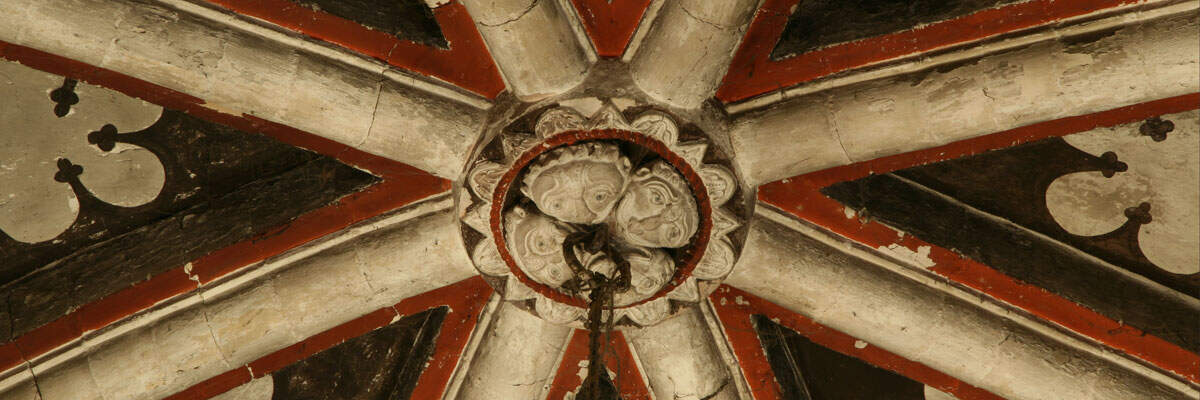
St Stephen, Winsham, Somerset

This item is active and ready to use
Location
(50°51′10″N, 2°53′21″W)
Site Location
Winsham
National Grid Reference
ST 375 063
Boundaries
pre-1974 traditional (England and Wales) Somerset now Somerset
Diocese
medieval Wells now Bath & Wells
Dedication
medieval St Stephen now St Stephen
Type of building/monument
Report authors
  • Robin Downes
Photographers
  • Robin Downes
Visit Date
22 May 2008

Please use this link to cite this page - https://www.crsbi.ac.uk/view-item?i=1178.

Find out how to cite the CRSBI website here.

Feature Sets
Description

Winsham is a small village 4mi SE of Chard, Somerset, on the road between Chard to the NW and Beaminster in Dorset to the SE via Broadwindsor. The older part of the settlement straddles that road as it runs down to Winsham Bridge across the river Axe which forms the border between Somerset and Dorset, SE of the village centre. Most of the village lies on Head deposits above the valley Alluvium. However, between Alluvium and Head are outcrops of Middle Lias (silts and marls); there are also thin bands of Upper Cretaceous rock― Gault (clay) and Upper Greensand― which curve up from the SW and peter out on the W side of the village high street, near the church, which lies at about 95m OD. The church of St Stephen, which is mostly of the 13thc and 15thc and built of local lias stone, consists of a nave with S porch, central axial tower, chancel and modern vestry. There are two scupltured heads on the E side of the chancel arch, one of which may be relevant to the Corpus.

History

Winsham was owned by the Bishop of Wells in 1066 and in 1086.

Features

Interior Features

Interior Decoration

Comments/Opinions

The head to the N appears to have been reset, possibly during the known 19thc alterations to the chancel. It may once have formed a corbel. The sculpture opposite is stylistically related but appears to be later in date; it may have been created to match the other one.

Thanks are due to Brian and Moira Gittos for drawing the author's attention to these sculptures.

Bibliography
  1. F. Arnold-Forster, Studies in Church Dedications (London, 1899), III, 309.

Historic England listing 1177765

  1. N. Pevsner, The Buildings of England: South and West Somerset (Harmondsworth, 1958), 349.

Somerset County Council, Historic Environment Record 57290. Online at http://webapp1.somerset.gov.uk/her/text.asp