All Saints, Godshill, Isle of Wight

This item is active and ready to use
Location
(50°38′0″N, 1°15′22″W)
Site Location
Godshill
National Grid Reference
SZ 527 818
Boundaries
pre-1974 traditional (England and Wales) Hampshire now Isle of Wight
Diocese
medieval Winchester now Portsmouth
Dedication
medieval All Saints now All Saints
Type of building/monument
Report authors
  • John Margham
Visit Date
2 June 2016

Please use this link to cite this page - https://www.crsbi.ac.uk/view-item?i=6321.

Find out how to cite the CRSBI website here.

Feature Sets
Description

The church is located on top of a locally prominent hill forming the core of the nucleated village of Godshill. The village lies to the N of the Isle of Wight’s southern chalk massif in the south-central area of the island. The church consists of a nave and chancel with no architectural division, a W tower, a wide S aisle, N and S transepts and a S porch. The lower stages of the tower probably date from the 14thc, as does the E end of the church. The S transept is of the late 15th or early 16thc (Lloyd and Pevsner 2006, 153-54). The only Romanesque feature is a loose capital

History

This was one of the churches given to Lyre between 1067 and 1071 (Hockey 1981, no. 4). There has never been a manor named Godshill, so the place-name was not recorded in 1086. The settlement did however have its own identity in the first half of the 12thc, for a William de Godeshelle witnessed a tithe agreement 1141x1147 (Hockey 1991,65). The first explicit reference to the church and place-name is Godeshull, 1155x1158 (Hockey 1981, 11).

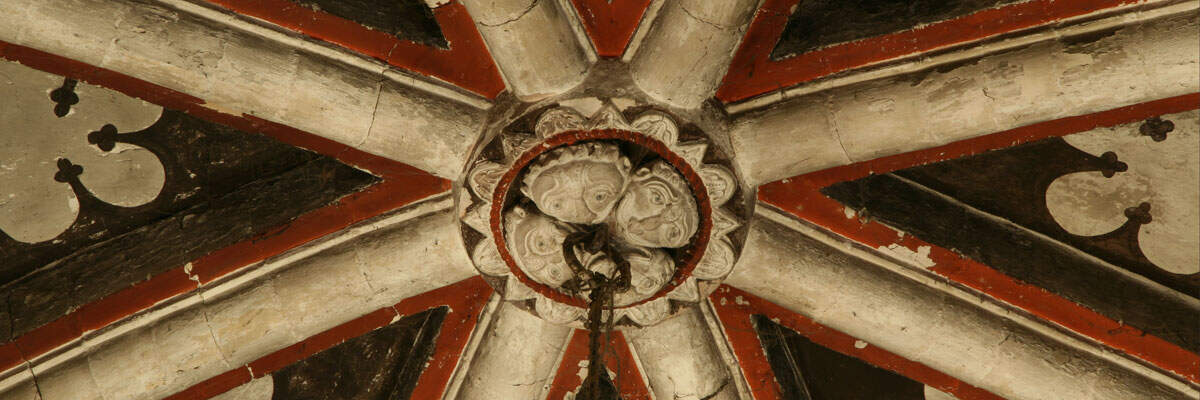
Features

Loose Sculpture

Comments/Opinions

Due to its size the capital would appear to have been part of a significant opening such as a chancel arch. It has been described as a ‘simple engaged cushion capital of eleventh-century type’ (Renn 1969, 267). Its form can be compared with those in the S transept of Winchester Cathedral, which was constructed from 1079 onwards, and several of the capitals in the crypt at Worcester Cathedral, commenced 1084 and consecrated 1089 (Fernie 2000, fig. 26; Barker and Guy 2008, 5-6).  

Bibliography

P. Barker and C. Guy, St Wulfstan 1008-1095: His life and times, Worcester 2008.

E. Fernie, The Architecture of Norman England, Oxford 2000.

S.F. Hockey, The Cartulary of Carisbrooke Priory, Isle of Wight Records Series 2, Newport 1981.

S.F. Hockey, The Charters of Quarr Abbey, Isle of Wight County Records Series 3, Newport 1991.

D.W. Lloyd and N. Pevsner, The Buildings of England: Isle of Wight, London and New Haven 2006.

D.F. Renn, ‘Some Early Island Churches’, Proceedings of the Isle of Wight Natural History and Archaeological Society 6 (1969), 266-70