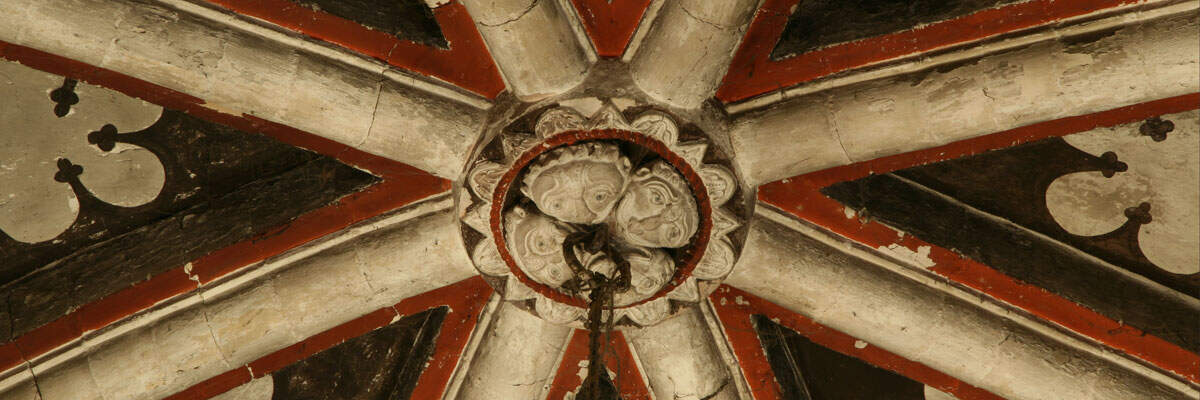
St Mary de Haura is first recorded between 1093 and 1139, when Philip de Braose (or Briouze), son of William de Braose, granted it to St Florent, near Saumur, on the Loire (Woodcock 1992, 91-92). Although this grant is traditionally thought to have been made between 1096 and 1103, a notification of 1144 indicates that it can be dated to the episcopacy of Seffrid I, who became Bishop of Chichester in 1125. A foundation date of c.1125-39 would agree with the style of the earliest surviving parts of the building, which appear to have been erected in the 1140s.
Mid-12thc. documents refer to the church as a chapel, which received all tithes pertaining to the port and all rents in tithe and so it must have accrued considerable wealth. By the 1170s, however, St Mary de Haura had become a parish church in its own right. It was in the late 12thc., when the port of New Shoreham was at its peak, that the rebuilding of the chancel was undertaken, and although this work has been associated with the baronage of William de Braose III, who fell from royal favour in 1212, there is no evidence of his direct involvement. The church was appropriated to the priory of St Peter at Sele, a cell of St Florent, in 1396. From 1459 until 1948 it was held by Magdalene College, Oxford, and in 1948 it was transferred to the See of Chichester.
The nave fell into disrepair in the 17thc., and by 1720 its eastern bay, deprived of its aisles, had been converted into a W porch (B.L. Add. MS. 5673, f.43). Otherwise, only a section of the W wall remained above ground.
The church was thoroughly restored in 1876 by Arthur Loader; it is worth noting that some of the stonework replaced at that time is now in a very poor condition. In 1915 the choir was excavated by Walter Marshall, revealing that the original chancel was narrower than the present structure, and had an apsidal termination. Scarring on the E faces of the transepts led Marshall to postulate apsidal chapels in these positions, but when the areas to the E of the transepts were excavated in 1949, only straight walls were uncovered. Rather than representing apsidal chapels, these were probably the remnants of aisles which would have been added to the original chancel, work which would have involved the demolition of any transept chapels standing prior to that time (Woodcock 1992, 93-94).
The Sele Cartulary, nd, refers to the dedication to St Mary De Haura.