
The Corpus of ROMANESQUE SCULPTURE in Britain & Ireland
St Peter ad Vincula (medieval)
Parish church
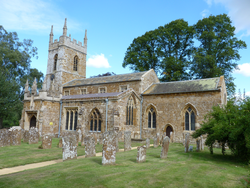
South Newington is a small village in the ironstone area of N Oxfordshire between Chipping Norton and Banbury. The early church probably existed in the mid-C12th, consisting of a chancel, nave and N aisle. There was a major remodelling c. 1300 that doubled it in size, adding the tower, S aisle, lengthening the nave, adding to the N aisle and adding a new chancel. The E bay of both aisles is of this date and wider than the others, indicating that the new chancel was extended further east. Clerestories were added in the C15th. St Peter’s is renowned for its high quality wall paintings. Remaining Romanesque features are two external buttresses, a N nave arcade of two bays with round arches and decorated capitals, and a font. There is also a sculpted head on the W respond of the N arcade, and some loose sculpture, that may be Romanesque.