
The Corpus of ROMANESQUE SCULPTURE in Britain & Ireland
St Peter and St Paul (formerly)
Parish church
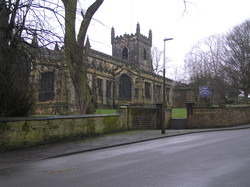
Birstall church is separated by a stream at the bottom of its churchyard from the core of the old town on the opposite hilltop. The churchyard is extensive and rises above the church. Carved pew-ends preserved in the church suggest that there was a good late medieval church, but that church was demolished and completely rebuilt 1863-1870 except for the W tower, the lower two levels of which are 12thc., and the belfry level 15thc. (Ryder 1993, 30, 142-3). The present building has an aisled chancel, a nave with double aisles, N and S porches, and a W tower enclosed by the aisles. On its E face a wall built since our first visit in 2000 fills the tower arch (plan in Cradock 1933, pl. 16).
The tower has slit windows on the N and S.
Otherwise, the Romanesque period is represented by fragments: most of a grave-marker or small coffin lid with lozenge decoration and a patterned font that has been broken in two but could be made serviceable. The 'sculpted' capitals mentioned by Sir Stephen Glynne do not seem to have been preserved.
Parish church
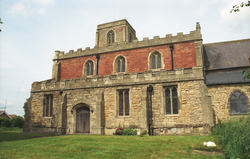
The church has a north west tower, an aisled nave, and chancel. It was restored in 1874-5. The church is built of a mixture of cut stone, rubble and (in the clerestory) medieval brick. The west wall is thick and may be that of the Norman nave (VCHER VII, 201). The only feature which might be relevant to this Corpus is a reset head at the W exterior face of the N aisle.