St Mary, Stanton Drew, Somerset

This item is active and ready to use
Location
(51°21′55″N, 2°34′43″W)
Site Location
Stanton Drew
National Grid Reference
ST 598 631
Boundaries
pre-1974 traditional (England and Wales) Somerset now Somerset
Diocese
medieval Wells now Bath & Wells
Dedication
medieval St Mary now St Mary
Type of building/monument
Report authors
  • Robin Downes
Photographers
  • Robin Downes
Visit Date
17 September 2009

Please use this link to cite this page - https://www.crsbi.ac.uk/view-item?i=12394.

Find out how to cite the CRSBI website here.

Feature Sets
Description

Stanton Drew, 8 miles S of Bristol, takes its name from the stone-tun belonging to Drogo (Bishop of Wells). The village lies hard by the river Chew, probably a very ancient valley settlement founded as near as possible to the famous Neolithic stone-arrangements, resting on Mercia Mudstone (formerly called Keuper Marl) Triassic bedrock. The church of St Mary is possibly of 13thc origin; the nave was rebuilt in 1848. It consists of N tower, nave N porch, NE chapel, wide S aisle and chapel and chancel. The font is Romanesque.

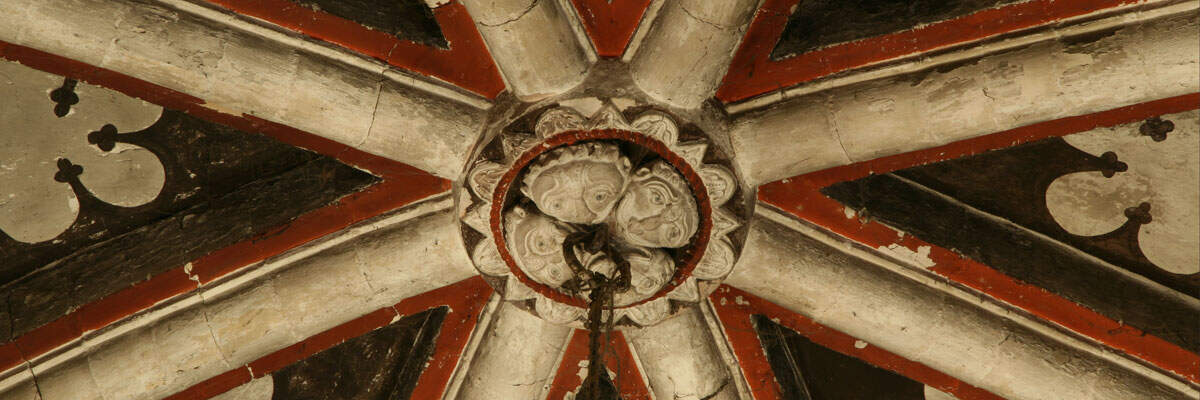
History

DB records that Roger held the manor of Stanton Drew as part of the royal possession of Keynsham. Subsequently the Lords of the Manor took their name from the village. In the reign of Henry II Robert de Stanton was succeeded by Geoffrey de Stanton. One of the family Drogo or Drew gave his name to the place to distinguish it from Stanton Prior and Stanton Wick (Robinson 1915). In 1291 Breamore Priory, Hampshire, is recorded as being in receipt of a pension of £1 from the rectory (VCH Hampshire).

Features

Furnishings

Fonts

Comments/Opinions

The listing text mentions the font but does not mention the question of date. On the one hand, the stem and bowl are identical in form with others dated to the Romanesque period known to the fieldworker. On the other, it has been suggested that it may be 13thc, which would fit with the claw tooling which is normally associated with a date after c.1200. This may therefore be a very late example on the Transitional Romanesque/ early Gothic divide.

Bibliography
  1. F. Arnold-Forster, Studies in Church Dedications (London, 1899), III, 264.

'Houses of Austin canons: Priory of Breamore', in A History of the County of Hampshire: Volume 2, ed. H. Arthur Doubleday and W. Page (London, 1903), 168-172. Online at http://www.british-history.ac.uk/vch/hants/vol2/pp168-172 [accessed 22 July 2022].

Historic England listing 1136209

  1. N. Pevsner, The Buildings of England: North Somerset and Bristol (Harmondsworth, 1958), 262.

W. J. Robinson, West Country Churches (Bristol, 1915), 202–205.